
-
Integrations
- Articles coming soon
-
Marketing
-
- Advertising white-label eCommerce solution to your customer ecosystem
- Advertising compliance and brand usage guidelines for partners
- How to create high-converting advertisements for your eCommerce platform
- How to run advertising campaigns to attract online merchants and resellers
- How to measure advertising performance and generate qualified merchant leads
-
- How to promote your eCommerce platform using consistent branding
- White-Label eCommerce branding strategy for partners
- Crafting effective brand messaging for eCommerce platforms
- Positioning your eCommerce platform for different merchant segments
- Maintaining brand consistency across marketing channels
-
- Creating High-Impact eCommerce marketing assets for partners
- Designing eCommerce sales decks that convert merchants
- Creating eCommerce landing pages that convert traffic into merchants
- Creating eCommerce case studies that build trust and close deals
- Creating Email campaigns that drive eCommerce adoption
-
-
Partner Hub
-
- Articles coming soon
-
- Articles coming soon
-
-
Sales
-
- Articles coming soon
-
- Articles coming soon
-
- Articles coming soon
-
- Articles coming soon
-
- Articles coming soon
-
-
Technical and Support
-
- Articles coming soon
-
- Articles coming soon
-
- Articles coming soon
-
- Articles coming soon
-
- Articles coming soon
-
- Articles coming soon
-
-
-
-
-
-
-
- Payment methods at eCommerce Store
- Setting up Stripe Payment Gateway
- Setting up Paypal in your Online Store
- Setting up CashFree Gateway
- Setting up RazorPay Gateway
- Setting up Paystack gateway
- Setting up Flutterwave Gateway
- Setting up Mercado Pago Gateway
- Setting up Mamo Pay Gateway
- Setting up Yoco Gateway
- Setting up Nets Easy Gateway
- Setting up Vipps Gateway
- Setting up Mollie Gateway
- Setting up Epoint Gateway
- Setting up Iyzico Gateway
- Setting up Payriff Gateway
- Setting up Crypto Payments through Nicky
- What is Cash on Delivery?
- Show Remaining Articles (3) Collapse Articles
-
- How to create an analytics account?
- Connecting Google Analytics to your eCommerce store
- Connecting Meta Pixel to your eCommerce store
- Connecting Tik Tok Pixel to your eCommerce store
- Connecting Google Tag Manager to your eCommerce store
- Managing product reviews & ratings in your eCommerce store
- Using marketing automation to drive urgency and social proof
- Setting up your LLMs.txt integration to boost your AI search visibility
- Automating manual order fulfilment and live tracking with Shiprocket
- Automating search engine discoverability with dynamic sitemaps
- Automate, optimise, scale: Building your Google shopping product feed
- How to sync your product catalog with meta ads to drive more sales
-
- Articles coming soon
-
- Articles coming soon
-
- Articles coming soon
-
Setting up Mamo Pay Payment Gateway
Mamo Pay is a full-stack payment services platform designed for SMEs in the UAE. It is widely used for fast and secure peer-to-peer and business payments. Users can send, receive, and request money instantly using their smartphone contacts, making it a convenient payment option for both merchants and customers.
Integrating Mamo Pay with your eCommerce store enables smooth online payments and simplified settlement directly in AED, regardless of the transaction currency.
How to set up Mamo Pay Payment Gateway
- Open Payment Settings
- Log in to your eCommerce Admin Panel.
- Navigate to Settings → Payments.
- Click on Add Payment Method.
- Select Mamo Pay
In the pop-up window, choose Mamo Pay as your payment provider.
If Mamo Pay isn’t listed, your store currency may not be supported. - Enable the Payment Method
Turn on the Enable Payment Method toggle to activate Mamo Pay. - Enter Your Mamo Pay Credentials
You need your Secret Key (API Key) from your Mamo Pay dashboard.
How to get your Secret Key:- Log in to your Mamo Pay Business Account.
- Go to your API Settings or Developers section.
- Copy your Secret Key (API Key).
- Paste the key in the eCommerce setup window and click Submit.
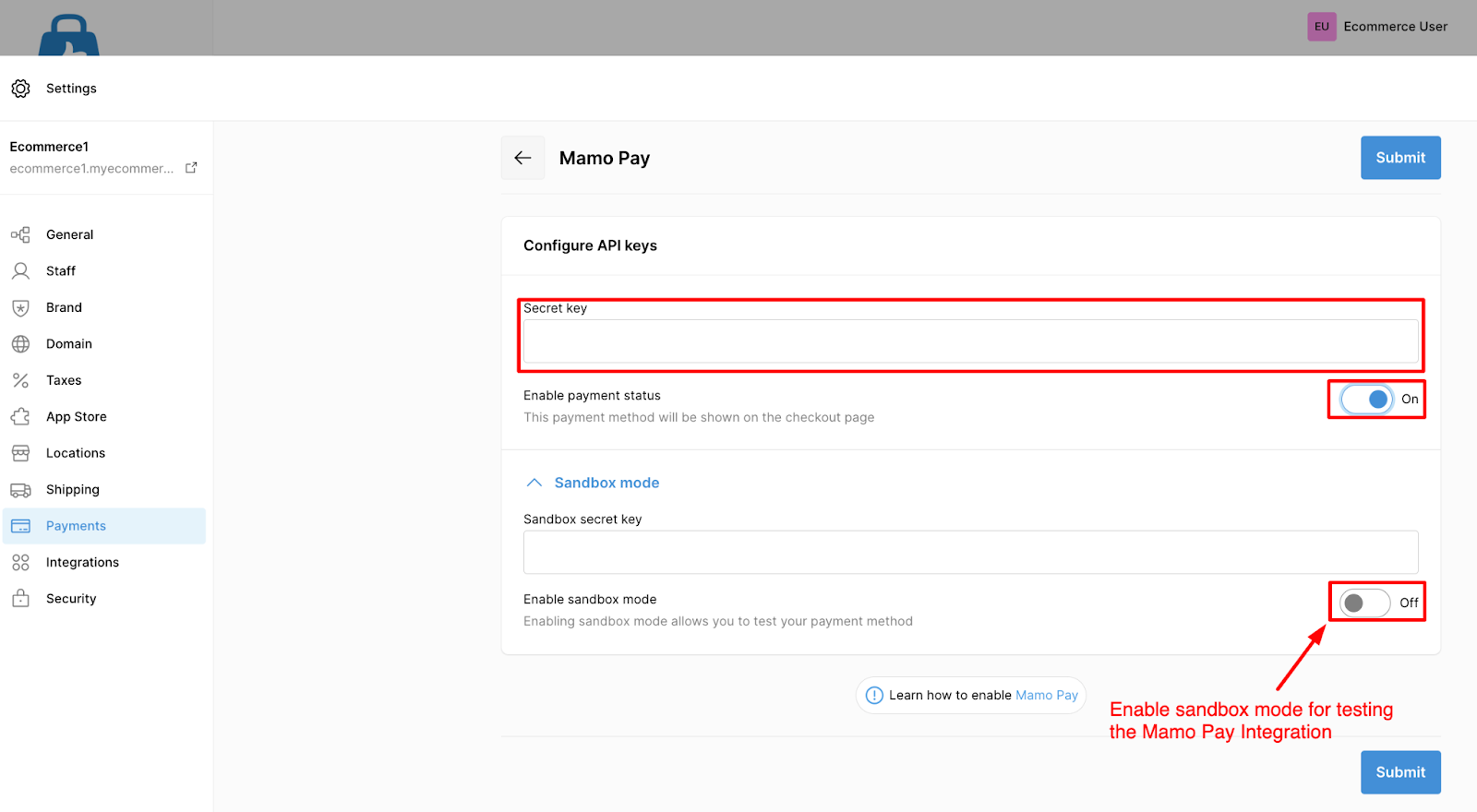
Sandbox Mode (Testing Environment)
You can test payments using Mamo Pay’s Sandbox mode:
- Go to More Options on the Mamo Pay setup page.
- Enable the Sandbox Mode toggle.
- Enter the same Secret Key in the Test Secret Key field.
- Save your changes.
This allows you to simulate payments during checkout without processing real transactions.
Mamo Pay Supported Currencies
Mamo Pay supports the following currencies for processing transactions:
| Currency Name | Code |
|---|---|
| United Arab Emirates Dirham | AED |
| United States Dollar | USD |
| Euro | EUR |
Mamo Pay isn’t available with your Store Currency
If Mamo Pay does not appear as a selectable payment method, your store currency is not supported by Mamo Pay. To fix this, you must change your store’s currency to one of the supported options.
How to change your Store Currency
- Go to Settings → General in your eCommerce admin panel.
- Click on Standards and Formats.
- Select a supported currency (AED, USD, or EUR) from the Currency dropdown.
- Save your changes.